News
One vision. Three siyaha. One basmala.
بسم الله الرحمن الرحيم
و الصلاة و السلام على أشرف المرسلين
و على اله و اصحابه أجمعين
One vision. Three siyaha. One basmala.
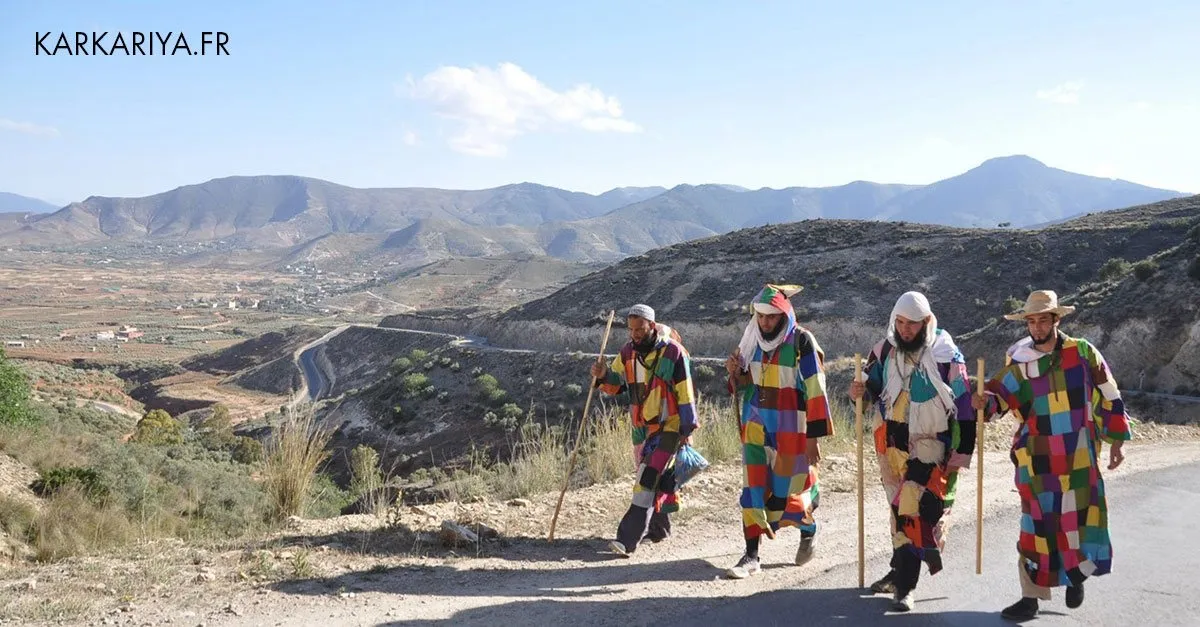
Having reached the maqam of Shaykh Mawlay al-Tahir al-Karkari (may Allah be pleased with him) after a siyaha of nearly 70 km, the fuqara, under the obedience of Shaykh Sidi Mohamed Faouzi Al Karkari (may Allah sanctify his secret), read the appropriate surahs. It was then that, in the middle of Surat Ya-Sin, Allah, Exalted be He, sent down into the heart of a murid who was present a vision in the waking state, which he recounts to us:
“During the recitation of Surat Ya-Sin, and by the grace of Allah and the permission of our shaykh Sidi Mohamed Faouzi Al Karkari (may Allah be pleased with him), I saw myself come out of the maqam and head for the top of a mountain. My body was in the maqam while my soul was climbing the mountain. Arriving at the summit, I saw from behind a man dressed in a white djellaba and wearing a turban. He was standing facing a cliff. After a few moments he turned towards me, and it was then that I recognised him: it was Shaykh Sidi Mawlay al-Tahir (may Allah be pleased with him). After coming up to me, he took me in his arms, thanking me for the siyaha made in his direction. He then said to me: ‘You must come back and make another siyaha, but this time head for the maqam of Sidi Mawlay al-Hassan.’ To which I answered: ‘O shaykh! Yet we visited him, and his maqam is next to yours.’ Shaykh Mawlay al-Tahir (may Allah be pleased with him) then made the triangle of the basmala appear before me. Facing the triangle floating in the air, he said to me: ‘When you left al-‘Aroui to head for my tomb, you set out with the intention of visiting my maqam, not that of Mawlay al-Hassan! You must complete the basmala!’ I then said: ‘How do I complete it?’ Shaykh Mawlay al-Tahir (may Allah be pleased with him) then showed me the points of the basmala, which appeared in the form of a triangle. He said to me: ‘Here is the point of Shaykh Ibn Qaddur al-Wakili, here is the point of Shaykh Sidi Mawlay al-Hassan, and here is my point; you must therefore visit and make a siyaha towards each of these maqams!’
Astonished, I then asked the shaykh: ‘Where is my shaykh Sidi Mohamed Faouzi Al Karkari in the triangle of the basmala?’ to which he replied: ‘He is in the centre!’ It was then that I came back to the world of the senses, finishing Surat Ya-Sin with the other fuqara.”
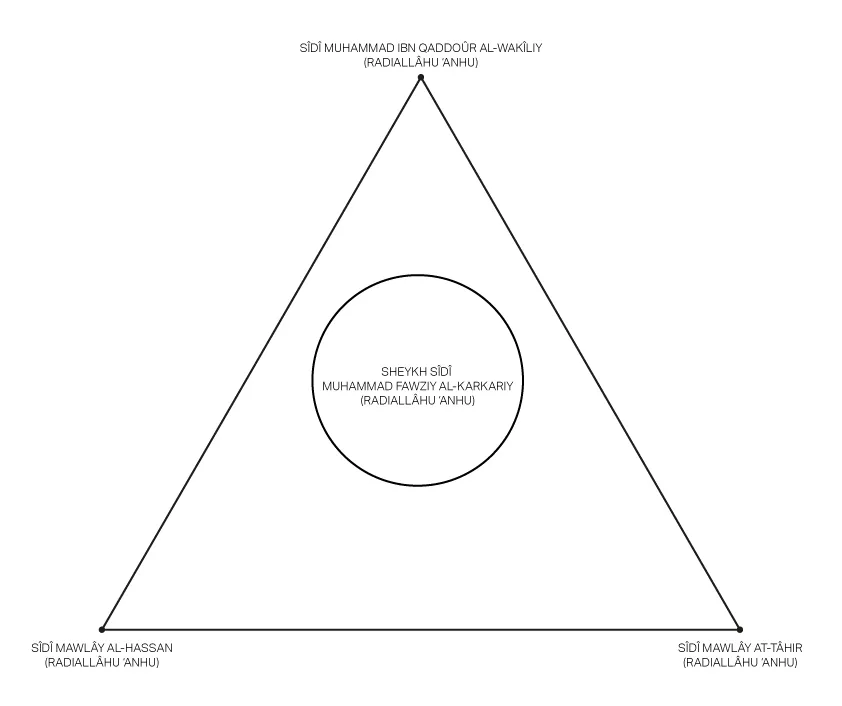
This vision gave rise to two siyaha. One towards the maqam of Mawlay al-Hassan al-Karkari (may Allah be pleased with him), who is none other than the shaykh of Sidi Mohamed Faouzi Al Karkari (may Allah sanctify his secret), and the other towards the maqam of the shaykh of our shuyukh, the master of Shaykh al-Buzidi, the pole Sidi Ibn Qaddour al-Wakili (may Allah be pleased with him).
Siyaha from al-Araoui to Temsemen (passing through Tiztoutine, Driouch & Tafersit)
During the first siyaha, the fuqara left the Karkariya zawiya around 1 a.m. and walked until the fajr prayer in the direction of the town of Tiztoutine (20 km). From there, after a stop, they headed until the maghrib prayer towards the town of Driouch (40 km), where they spent the night. The next day they took the road to Tafersit and climbed the mountains leading to Tamsaman. The fuqara then stopped at the entrance to the town as the sun was setting. Delighted by the spiritual state that accompanied them, the fuqara held a hadra. The hearts of the villagers were softened by the songs on the Prophet ﷺ, and they allowed the fuqara to sleep in the mosque (40 km).
The next day the fuqara completed their siyaha and were welcomed by the name of Allah written in the sky (which would also happen in the following siyaha) as they approached the maqam. On arrival at the maqam, the evening ended with dhikr and songs on the Prophet ﷺ.
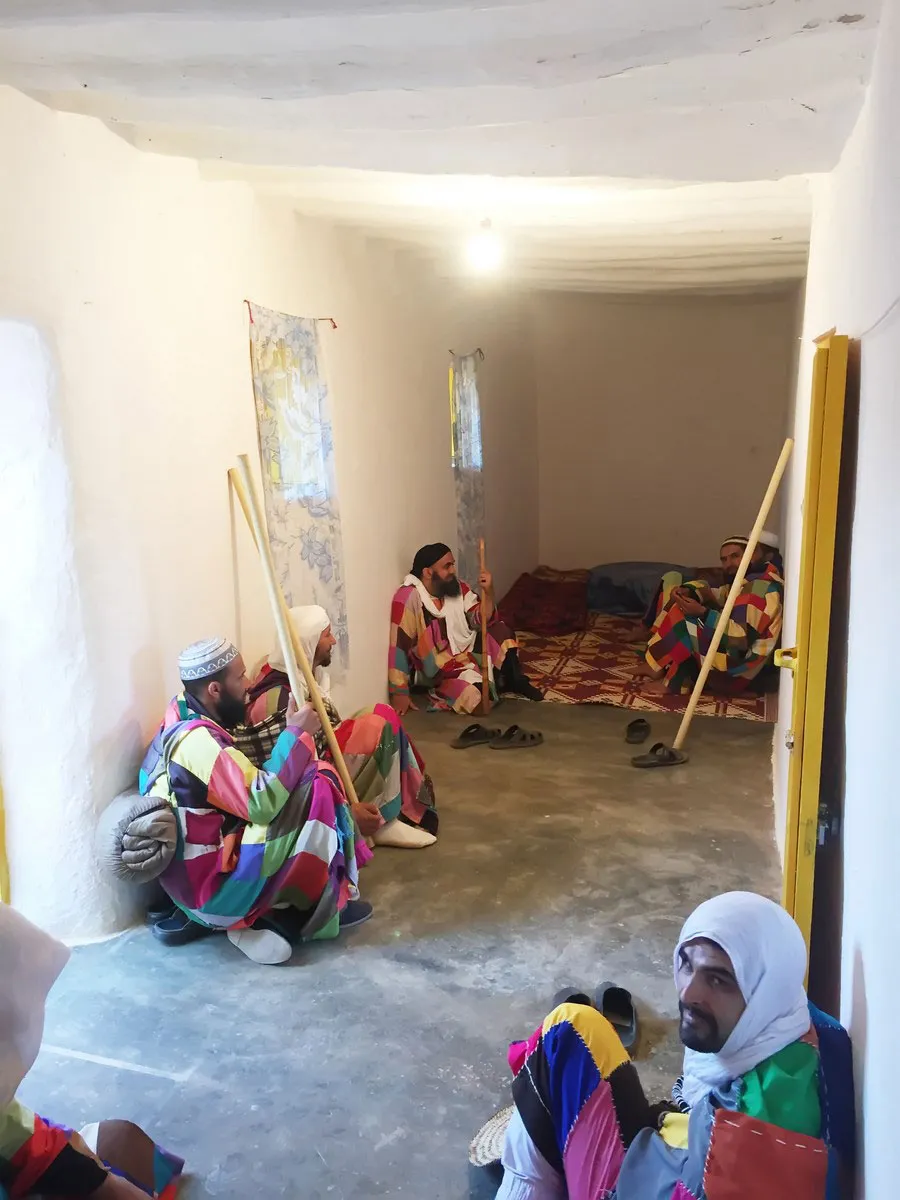
It is here that Mawlay Tahir lived and where our shaykh grew up
Siyaha from al-Araoui to Mount Karkar
The fuqara set out on the 13th day of the month of Ramadan. The siyaha was thus made while fasting and under a blazing sun. It consisted of only one stage of 40 km, which the disciples completed in a single day. On arriving at the maqam, and after being joined by Shaykh Sidi Mohamed Faouzi Al Karkari (may Allah sanctify his secret), an evening of dhikr took place in the tomb itself. The maqam was on the mountain of Karkar, where Shaykh Ibn Qaddour al-Wakili settled, nicknamed al-Karkari because he lived on this mountain. He was the shaykh of Shaykh al-Buzidi and of Shaykh Muhammad al-Hebri: in other words, the ‘Alawiyya and Hebriyya-Belqaidiyya paths come from him. He is also the great-grandfather of our shaykh, and that is how his descendants came to be called the Karkari.
After spending the night there, the disciples headed for al-Aroui, crossing paths in the middle of the Karkar mountain that revealed impressive landscapes. After 30 km, the disciples finally arrived at the Karkariya zawiya and were welcomed by their shaykh, Sidi Mohamed Faouzi Al Karkari (may Allah sanctify his secret), as well as by the name Allah (in the sky) at the entrance to the town.
The fuqara thus wrote, in the Mulk, the talisman of the Basmala through their siyaha: during the 1st of the 3 siyaha, the fuqara numbered 12, the number of letters in the word of tawhid la ilaha illa Allah. During the 3rd and last siyaha, the fuqara numbered 19, the number of letters in the basmala… and this without the slightest outside intervention… a sign for those who have a heart.