News
Karkariya visit: Paris Mosque / Les Ulis Mosque (28/03/2014)
و على اله و اصحابه أجمعين
Visit: the Paris Mosque and the Les Ulis Mosque, during a Tijani conference On the occasion of a conference held at the new mosque of Les Ulis, the Karkari brothers first visited a few brothers at the Paris Mosque and then went to Les Ulis to follow the lectures on the theme: · First talk“Islam, Iman and Ihsan: the three stations of the Muslim religion”, after the book of Ibn ‘Ashir
By Tarik Bengarai: Tarik Abu Nur is a researcher in Islamic law and Islamic finance. Author of several books on Islamic law, the Sira and Islamic finance, Shaykh Tarik is manager and co-founder of the site doctrine-malikite. He is also secretary general of the Independent Committee for Islamic Finance in Europe, a member of the interfaith dialogue group Artisan de Paix, and co-founder and treasurer of the French association of executives of immigrant background.
· Second talk “Shiites and Sunnis: brothers or enemies?” By Shaykh Tijani Sall: Shaykh Tijani Sall, after memorising the Qur’an very young, studied the religious sciences for seven years with the teachers and scholars of the Fouta region in Senegal, before settling in Mbour in Senegal to teach the religious sciences and keep the company of the master and scholar Shaykh Muhammad Al Mansour Barro for several years. Shaykh Tijani arrived in France in the early 1990s, where he has never ceased to preach an Islam of fraternity and sharing. A charismatic speaker, he has given lectures on spirituality and the reform of hearts in several countries, such as Spain, Morocco, Senegal, Ivory Coast, Ghana, Togo and Benin. He is a religious referent and honorary member of the associations Nouveaux Musulmans de Paris and Perle De La Perfection, and is president of the Cultural Association for the Tolerance of Islam in France.Visit to the brothers at the Paris Mosque To our great surprise we met several brothers, which led to a few confrontations of ideas, sometimes heated, but the important thing is that fraternity prevails over our differences. The proof in a photo: a brother with whom our ideas, our themes on Facebook and our vision of jihad are radically opposed. Yet we remain brothers, hence the importance of knowing how to listen to the other’s opinion, with our weaknesses and our imperfections From right to left, Sidi Mohamed, Sidi Mustafa and Sidi Hatim
Visit to the Les Ulis Mosque during the conference Poster of the programme including the 2 lectures The speakers: – Shaykh Tijani Sall – And Tarik Bengarai of the Butshishiyya tariqa (Shaykh Hamza of Morocco)
Brother Hatim’s intervention concerning an event of Shaykh Ahmad Tijani and of a murid who wished to see the Prophet (peace and blessings be upon him). This event relates a strong light at the unveiling of the Prophet. According to my understanding of Shaykh Tijani’s explanations, this light is less important than seeing the perfect vision in one’s body; of the Prophet (peace and blessings be upon him)
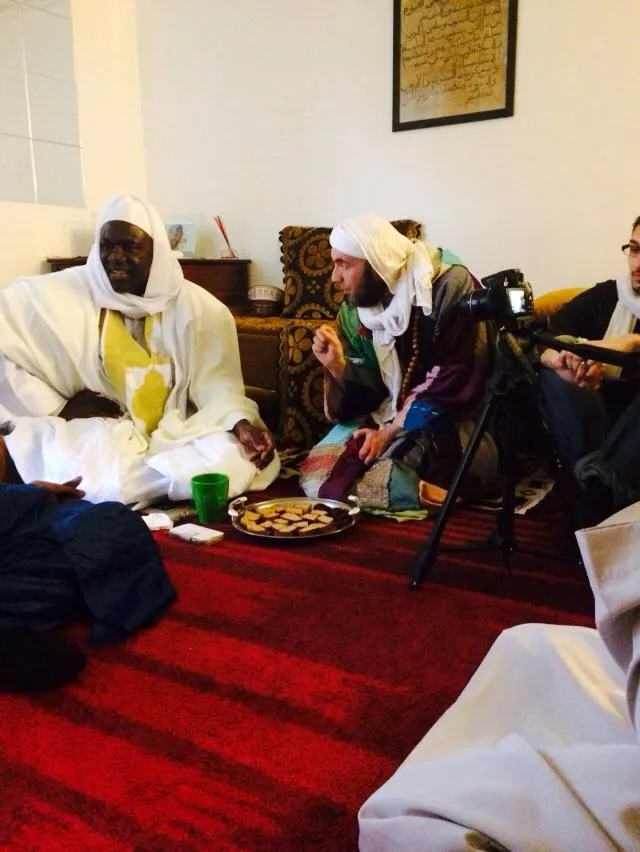
Below, a few brothers we met during the conference. The intervention found no answer during the conference, the Shaykh preferring to give his answer during an invitation in a small Tijani zawiya (may Allah bless the brother for the sacrifice of his home). At the end of this interview it appears that there are notable differences between the 2 turuq (the Karkariya Sufi Order and the Tijaniyya), certainly due to my lack of knowledge and attainment, but I noted the following points · A divergence on the notion of Kamal (perfection) and of Nuqsan (diminution) · On the notion of Fana (extinction) · The notion of existence in the declaration of faith (the La nafi) In conclusion:According to Shaykh Tijani Sall, it appears that the Tijanis possess numerous karamat concerning the real vision of the Prophets. Regarding gnosis (ma‘rifa), the interview did not allow this notion to be shared; we hope for a next meeting. May Allah preserve us in the tariqa of Sidi Shaykh Mohammed Faouzi ElKarkari, who, with very little time spent with him, enabled us to debate with the Shuyukh of other turuq as a simple faqir.