Teachings
Siyaha among the Sufi masters: walking to seek God
History, accounts and writings on spiritual wandering, from the Qur’an to the masters of the Maghreb
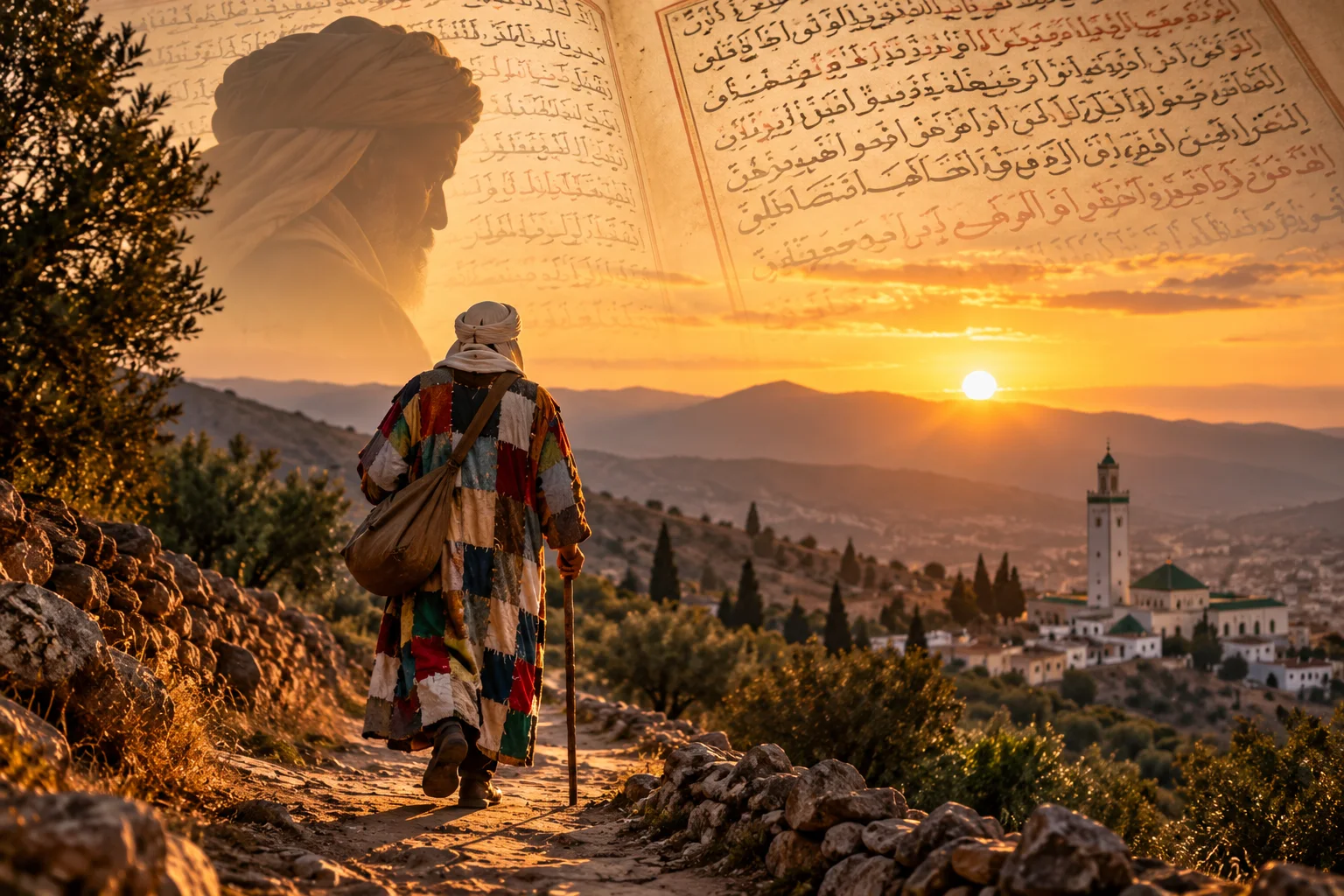
Setting out on the roads, with no destination, relying on God for one’s sustenance: this form of ascetic travel, called siyaha, runs through the whole history of Sufism. This article traces its foundations, the figures who practised it, the texts in which the masters speak of it and the debates it has provoked.
What is siyaha?
The Arabic word siyaha comes from the root s-y-h, which evokes the idea of going to and fro, of wandering. In early Sufi literature, it designates a particular form of travel: solitary wandering, without provisions, practised by certain ascetics and Sufis. It is distinguished from safar, a more general word that covers all the journeys of medieval Islamic culture (pilgrimage, the pursuit of knowledge, trade, visits to masters).
The scholar Arin Salamah-Qudsi, in her study “Crossing the Desert: Siyāḥa and Safar as Key Concepts in Early Sufi Literature and Life” (Journal of Sufi Studies, 2013), shows that travel was a common ascetic way of life among the early Sufis between the 3rd/9th and the 6th/12th century. Some masters regarded siyaha as a means of facilitating inner awakening, what the tradition calls the “science of the inward” (ʿilm al-bātin).
Two ideas recur constantly in the texts: detachment (leaving one’s home, one’s habits, one’s material securities) and trust in God, tawakkul (relying on Him for food, shelter and the road).
The foundations: the Qur’an and the prophetic tradition
The Qur’an repeatedly invites us to “travel through the earth” in order to observe and reflect: “Say: Travel through the land and see how He began creation” (29:20); “Travel through the land, then see what was the end of those who denied” (6:11; see also 3:137); “It is He who made the earth tame for you, so walk among its slopes and eat of His provision” (67:15). These verses speak first of travel and reflection; the Sufis found in them a legitimacy for spiritual walking.
Two verses (9:112 and 66:5) use the word sāʾiḥūn / sāʾiḥāt, from the same root as siyaha, in the list of the qualities of the believers. The commentators interpret it variously: many see in it those who fast (this is the opinion reported from Ibn ʿAbbas), since the one who fasts deprives himself, like the traveller, of the pleasures of the world; others understand it as those who emigrate for their faith or who travel for knowledge.
A hadith transmitted by Abu Dawud (no. 2486) reports that a man asked the Prophet for permission to practise siyaha; he replied: “The siyaha of my community is striving (jihād) in the path of God.” It is often cited in connection with the saying “there is no monasticism in Islam”: it invites us not to turn wandering into a renunciation of social life. Another hadith, reported by al-Bukhari on the authority of Ibn ʿUmar, is dear to the Sufis: “Be in this world as a stranger or a traveller.”
This tension between itinerant asceticism, which the masters practised, and the warning against a renunciation cut off from the community, runs through the whole history of siyaha.
The early centuries: princes, ascetics and walkers
Ibrahim ibn Adham (d. c. 777-782) is the archetype of the sovereign turned wanderer. A prince of Balkh, according to tradition, he gave up his throne and his wealth to lead the life of an itinerant dervish. The accounts show him travelling through Syria, meeting in Mecca figures such as Sufyan al-Thawri and al-Fudayl ibn ʿIyad, working with his hands to live. The anecdotes about his life fed all the collections of biographies of saints, down to ʿAttar’s Tadhkirat al-awliya’.
Dhu l-Nun al-Misri (d. c. 860), a founding figure of Egyptian Sufism, travelled in Egypt, Arabia, Syria and Persia, to various masters. His sayings on the knowledge of God (maʿrifa) were collected by later generations.
Abu Yazid al-Bistami (d. 874-877), according to the hagiographic tradition, left his village after obtaining his mother’s blessing and wandered from country to country for thirty years, in sleeplessness and hunger, before returning to Bistam.
Ibrahim al-Khawwas (d. c. 904), whom the Persian al-Hujwiri calls “the chief of those who rely on God”, is the great name of tawakkul in travel. His accounts show him walking in the desert without provisions; one of them tells how, after three days without eating or drinking, he felt doubt pass through him and drew a lesson from it. He is credited with this saying that sums up the attitude: not to burden oneself with what God has already taken charge of, and not to waste what is entrusted to us. Later, Jaʿfar al-Khuldi (d. 959) is said to have performed twenty-one pilgrimages to Mecca on foot, without water or food, following the way of trust in God.
What the manuals of the path say
From the 11th century, the great treatises that systematise Sufism include the question of travel. The Risala of al-Qushayri (1045), the most widely circulated manual in the Islamic world, devotes a chapter to the rules of travel and describes the behaviour expected of the Sufi on the road. The Kashf al-mahjub (“The Unveiling of the Veiled”) of al-Hujwiri (d. c. 1072), the oldest Persian treatise on Sufism, owes much to its author, a great traveller: Hujwiri travelled through Khorasan, Iraq, Syria, Turkestan and Transoxiana before settling in Lahore, and it was along these roads that he met the masters whose words he reports. The ʿAwarif al-maʿarif of Shihab al-Din al-Suhrawardi (d. 1234), another very popular manual, also deals with the conduct of the traveller.
The masters there generally recommend setting out with the master’s permission and in the company of brothers, remaining in a state of purity, praying on the road, avoiding being a burden on others and not putting oneself in needless danger. Entirely solitary siyaha without provisions then appears as a path reserved for a few, based on a tested trust in God.
The vocabulary itself is revealing: Manazil al-sa’irin (“The Stations of the Travellers”) by ʿAbd Allah al-Ansari al-Harawi (d. 1089) describes spiritual progress as a journey (sayr) in a hundred stages. The outward movement of siyaha thus nourished the central metaphor of Sufism, that of the inner path: the traveller (sālik), the way (tarīqa), the stations (maqāmāt).
Al-Ghazali: leaving Baghdad to walk
One of the best-documented accounts is that of Abu Hamid al-Ghazali (1058-1111). A renowned professor at the Nizamiyya madrasa of Baghdad, he went through a spiritual crisis that he himself recounts in his autobiography, al-Munqidh min al-dalal (“Deliverance from Error”). In November 1095, he left Baghdad. He stayed in Damascus, then went to Jerusalem and Hebron, reached Medina and Mecca for the pilgrimage of November-December 1096, returned for a time to Damascus, before finally coming home to Tus.
The early biographers sometimes speak of ten years spent in Syria; scholars point out that, according to the Munqidh itself, he stayed there about two years. The whole period of retreat and travel nevertheless lasts about ten years: al-Ghazali resumed teaching in 1106 at Nishapur. His case illustrates a frequent pattern: walking and retreat as a time of transformation, followed by a return to transmission.
ʿAbd al-Qadir al-Jilani: twenty-five years in the deserts of Iraq
ʿAbd al-Qadir al-Jilani (c. 1077-1166), founder of the Qadiriyya, is said to have arrived in Baghdad as a young man to study. According to the hagiographic tradition, he then lived for twenty-five years as a recluse, wandering in the deserts of Iraq, before reappearing in Baghdad in 1127, at about fifty years of age, and becoming a much-followed preacher there. His sermons were collected in works such as the Futuh al-ghayb. As is often the case in this kind of account, the precise chronology belongs to tradition more than to the archives, but the figure of the master who came out of the desert to teach has become a model.
In the Maghreb: walkers and masters
The Maghreb has a long tradition of itinerant masters. Abu Yaza (d. c. 1177), an unlettered Berber master of the Middle Atlas, lived in the mountains of the Khenifra region; the biographers say that many disciples came to him. One of his pupils, Abu Madyan (born c. 1115 near Seville, d. 1198), became the great master of the Maghreb: a shepherd in his youth, he went to Marrakesh and then to Fez to study, before settling in Bejaia, where he taught. Summoned to the Almohad caliph, he died on the way near Tlemcen, where he is buried at al-ʿUbbad. The question of his journey to the East is debated by scholars.
Abu al-Hasan ash-Shadhili (1196-1258) left Morocco in search of a master, passed through Iraq, returned to the Maghreb where he found ʿAbd as-Salam ibn Mashish on Jabal al-ʿAlam, settled in Tunis and then in Alexandria, and died in 1258 at Humaythara while on his way to the pilgrimage. His name remains attached to one of the greatest Sufi paths.
Ibn al-ʿArabi (1165-1240), born in Murcia and trained in Seville, devoted about ten years to travelling through al-Andalus and North Africa to meet masters (Tunis, Fez, Cordoba). In 1202, he set out from Cairo for Jerusalem and then Mecca, where he began his Futuhat; he then travelled to Anatolia and Syria and settled in Damascus, where he died. His writings describe travel sometimes as a real journey, sometimes as an image of the inner quest.
Later, Ahmad Zarruq (1442-1493) left Fez, stayed in Medina and Cairo, taught at Al-Azhar and ended his life at Misrata; Ahmad al-Tijani (1737-1815), founder of the Tijaniyya, was an itinerant scholar who passed through Tlemcen, Fez, Tunis, Mecca (1773), Medina and Cairo before settling; and Ahmad al-ʿAlawi (1869-1934) undertook, after the death of his master in 1909, a journey of several months to Tunis, Tripoli and Istanbul before resuming the direction of his path at Mostaganem.
The East and Central Asia: dervishes and vagabonds of God
In the Persian and Turkish world, the tradition of itinerant dervishes took very visible forms. The Qalandars are wandering ascetics who, from the 12th century, spread through Khorasan and then Central Asia, India, Anatolia and Egypt; with no common rule or single affiliation to a brotherhood, they made wandering, poverty and stripping away a way of life.
Shams of Tabriz (c. 1185-1248), the companion of Rumi, spent most of his life as a wandering dervish, in search of a spiritual companion: he is placed in Baghdad, Damascus, Aleppo, Kayseri, Sivas and elsewhere, before his decisive meeting with Rumi in Konya. In India, Muʿin al-Din Chishti (c. 1142-1236), originally from Sistan, accompanied his master ʿUthman Haruni for about twenty years through many lands, then, according to tradition, reached Samarkand, Bukhara, Baghdad, Mecca, Medina and Lahore before settling in Ajmer around 1192, where the Chishtiyya would be born.
Debates and criticisms
Siyaha has never commanded unanimity. Several jurists warned against setting out without provisions, which exposes the traveller to danger and leads him to depend on others, or against abandoning family and social life. Authors such as Ibn al-Jawzi (d. 1201), in the Talbis Iblis (“The Deception of Iblis”), attack Sufi practices they judge excessive, often in their public dimension, while recognising the value of authentic piety.
The Sufi masters, for their part, responded by framing the practice: travelling with the permission of a guide, in the company of brothers, respecting the religious law and without neglecting one’s duties to one’s family. Many ended up fixing siyaha to a limited time, after which the walker returns to a community. In these texts, wandering is a stage, not a final state.
What walking teaches
Beyond the diversity of eras and places, the accounts of siyaha outline a few constants. Walking is first of all a school of detachment: without a house, without reserves, the traveller discovers what he can do without. It is also a school of trust (tawakkul): sustenance, shelter and direction are no longer planned but received. Lastly, it teaches humility and service: the walker depends on the hospitality of those he meets and learns to see each encounter as a gift.
In most biographies, the walking leads to an encounter: that of a master (Shams of Tabriz and Rumi, ash-Shadhili and Ibn Mashish, Muʿin al-Din Chishti and ʿUthman Haruni), sometimes to a return to teaching (al-Ghazali at Nishapur, al-Jilani in Baghdad). The pilgrimage is not the goal: it prepares the heart for what follows.
The walk of Shaykh Mohamed Faouzi Al Karkari
It is within this long tradition that the ten-year walk of Shaykh Mohamed Faouzi Al Karkari across Morocco, from 1994 to 2004, belongs: a wandering alone and without destination, in quest of his Lord, which ended with the meeting of his master, Mawlay al-Hassan, in 2004. He himself spoke of it in 2023, at the University of Chicago, in an interview on “walking as a spiritual practice”.
Read: a 10-year walk across Morocco→
Sources and further reading
- Arin Salamah-Qudsi, “Crossing the Desert: Siyāḥa and Safar as Key Concepts in Early Sufi Literature and Life”, Journal of Sufi Studies 2/2 (2013), pp. 129-147.
- Abu al-Qasim al-Qushayri, al-Risala al-Qushayriyya (1045).
- ʿAli al-Hujwiri, Kashf al-mahjub (11th century).
- Abu Hamid al-Ghazali, al-Munqidh min al-dalal; entry “al-Ghazālī” in the Encyclopaedia of Islam, ghazali.org.
- ʿAbd Allah al-Ansari al-Harawi, Manazil al-sa'irin (“The Stations of the Travellers”).
- Ibn al-Jawzi, Talbis Iblis (12th century).
- Abu Dawud, Sunan, no. 2486: sunnah.com. Commentary on verse 9:112: tafsir Maʿarif al-Qurʾan.
- “ʿAbd al-Qāder Jilāni”, Encyclopaedia Iranica: iranicaonline.org.
- Biographical entries consulted: Abu Madyan, Ahmad al-Tijani, Shams Tabrizi, Muʿin al-Din Chishti.
The life accounts of the masters belong largely to the hagiographic tradition: dates and durations in them are often approximate. We report them as such, noting the divergences when they are known.